
What is barge flashing?
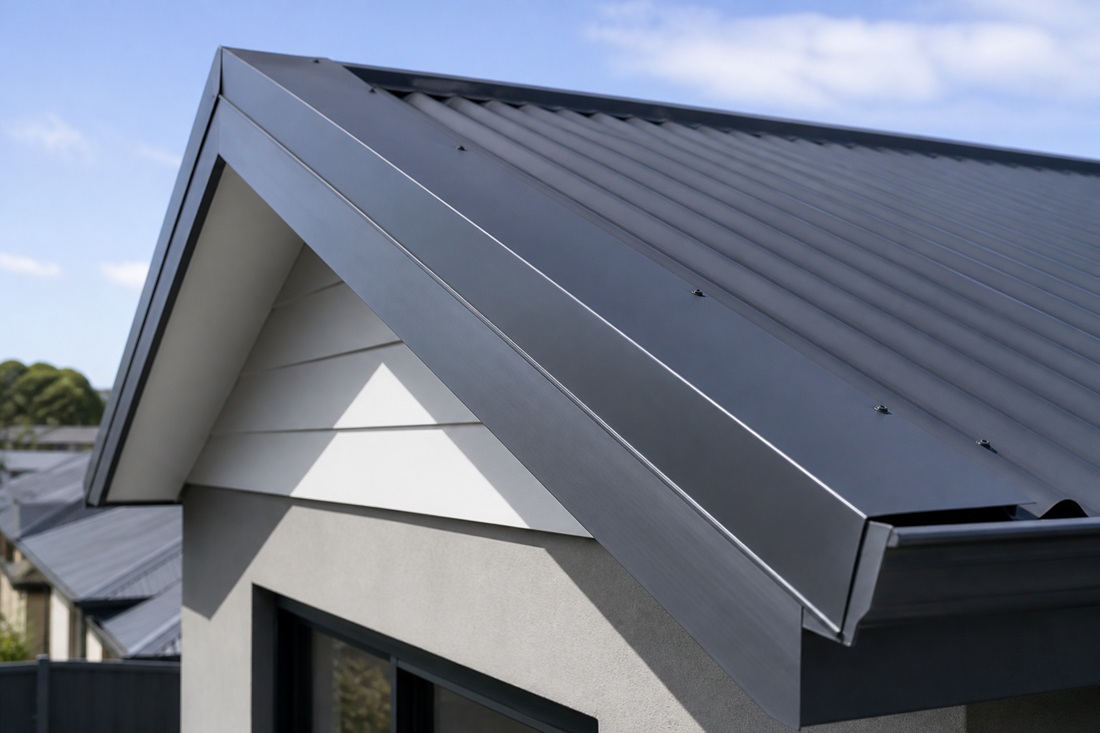
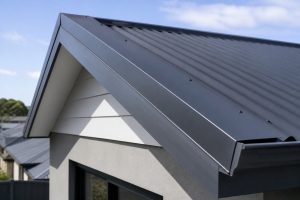
Barge flashing is the metal flashing fitted along the sloping edge of a gable roof, where the roof meets the outside edge of the wall or barge board. Barge flashing is what helps turn that roof edge into a weather-resistant detail rather than leaving it exposed.
Its purpose is to:
- protect the roof edge
- help direct water away from the structure
- support the finishing detail at the gable end
- improve the appearance of the roof perimeter
What is the difference between corner and barge flashing?
The two are related, but they are not the same.
Barge flashing is specifically used along the sloping gable edge of a roof. It is designed to protect that roof edge and cover the junction where the roof sheeting ends. A barge flashing may include folded corners as part of the installation.
Corner flashing usually refers to flashing used to protect an external or internal corner where two surfaces meet, such as cladding corners, parapet returns, wall junctions, or roof-to-wall transitions.
Can I put new flashing over old flashing?
Sometimes yes, but it is not always the best option.
New flashing can sometimes be installed over old flashing if:
- the existing flashing is sound
- there is no trapped corrosion underneath
- the build-up will not interfere with water flow
- the new detail still meets the roof system requirements
In many cases, installing new flashing over old flashing only hides underlying problems rather than fixing them. If the old flashing has failed for any reason, covering it may only delay the leak.
The better approach is to inspect the existing condition first. If the old flashing is deteriorated, poorly fixed, or incorrectly detailed, removal and then replacement is the better solution long term.
See all our flashing products here.
What are the Australian standards for flashing?
In Australia, flashing work is generally tied to the National Construction Code, relevant Australian Standards for roof and wall cladding systems, and the installation requirements of the product manufacturer.
In practice, Australian flashing should be:
- suitable for the exposure conditions
- installed so water is directed out, not trapped
- compatible with adjoining materials
- fixed and lapped correctly
- compliant with the relevant roof or wall system requirements
Can missing flashing cause mould?
Yes. Missing flashing can lead to mould.
Flashing is there to stop water entering vulnerable joints. If flashing is missing or even damaged, water can get into roof spaces, wall cavities, insulation, plasterboard, or timber framing. Once moisture is trapped, mould can develop, especially in areas with low ventilation.
The flashing itself does not cause mould. The problem is the water ingress caused by the missing or failed flashing. Left untreated, that can also lead to rot, corrosion, stained ceilings, and damage to internal finishes.
How long will aluminium flashing last?
Aluminium flashing can last for decades if it is correctly installed and used in the right environment. But poor installation, mechanical damage, or contact with incompatible materials can shorten that lifespan significantly. Its service life depends on:
- exposure conditions
- proximity to coastal or industrial environments
- thickness of the material
- quality of installation
- compatibility with adjacent metals and fixings
- ongoing maintenance
Is aluminium flashing better than galvanized?
Not always. It depends on the application.
Aluminium flashing advantages:
- lightweight
- corrosion resistant
- easier to handle in many situations
- good for some exposed environments
Galvanized flashing advantages:
- strong and durable
- commonly used in general construction
- often cost-effective
- suits many standard roof flashing applications
The main issue is not which is better, but which is better for the specific roof, wall, and environment. In coastal conditions, corrosion resistance becomes more important. In other applications, galvanized steel may be the more practical choice.
Conclusion
Barge flashing is the flashing used along the gable edge of a roof to protect the roofline, stop water ingress, and create a neat, finished edge. It is different from corner flashing because it is designed specifically for the sloping roof edge rather than a general corner junction.
For more information on the flashings, we have available, contact our sales team at (08) 9399 3276.