
Fencing regulations to check before installation in Perth
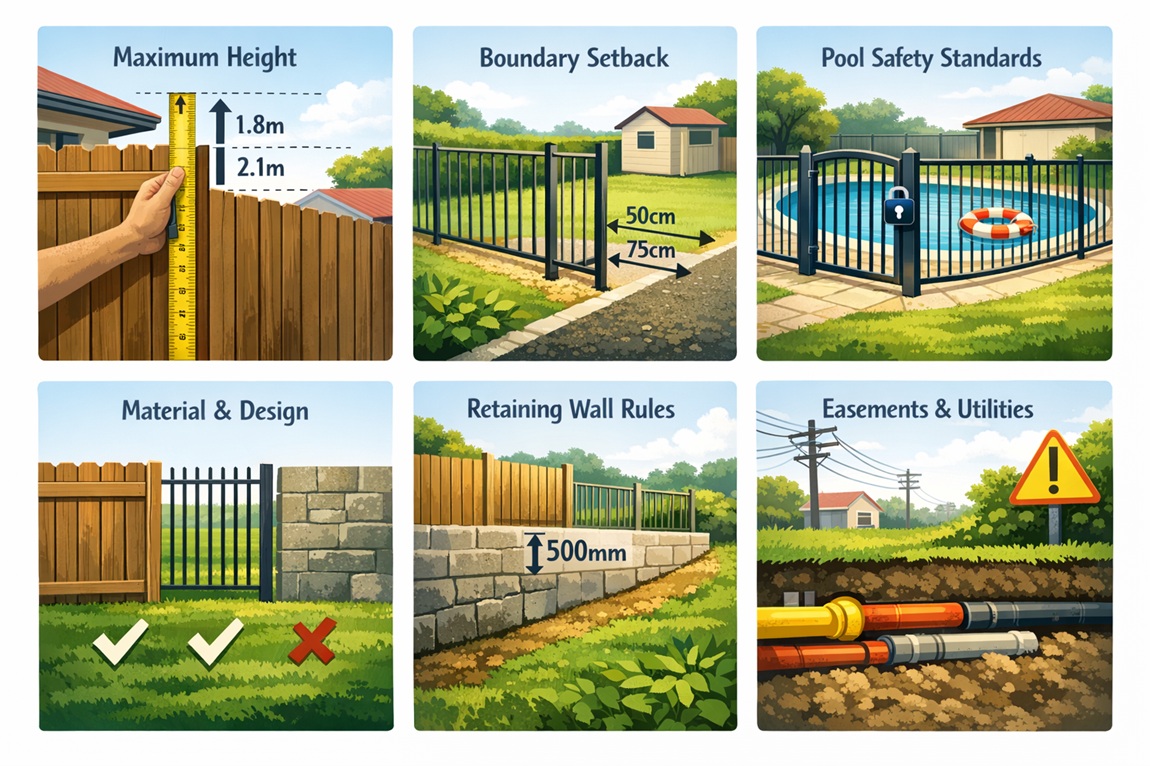
Fence rules in Perth can vary a bit between councils, but these are the main things to confirm before you install.
1) Dividing fences (boundary fences with neighbours)
If the fence sits on the boundary between two properties, it’s usually treated as a “dividing fence” issue.
Cost sharing and responsibilities are generally handled under WA’s Dividing Fences Act 1961.
The best practice is to talk to your neighbour before you remove/replace anything, agree on the type/height/material, and keep it in writing (even an email).
Most disputes come from replacing a shared fence without agreement.
2) Do you need council approval?
This depends on your local council and the type of fence.
As a simple rule of thumb:
Many standard residential boundary fences (like Colorbond or timber) often don’t need building approval if they’re installed to typical standards.
Brick or masonry fences are more likely to trigger approvals. For example, the City of Canning notes building approval is required if a brick/masonry fence is over 0.75 m.
Before ordering materials, check your council website or call them especially if your fence is:
- brick/masonry
- higher than usual
- near a retaining wall
- on a corner block or near vehicle sightlines
3) Front fences are usually more restricted than side/back fences
In many Perth councils, front fences must maintain street appearance and visibility.
Common approach (varies by council):
- solid fencing is often allowed only to a lower height (commonly around 1.2 m), and
- anything taller may need to be more “open”/see-through up to a higher limit (often around 1.8 m).
Confirm your suburb’s front fence rules with your council (they may reference the R-Codes and local planning policies).
4) Pool fencing is a special case
If any part of your fence is being used as a pool or spa safety barrier, treat it as a compliance job.
Pools/spas (including portable pools) with more than 300 mm water depth require a compliant safety barrier.
See WA’s building regulations, the NCC, and standards - AS 1926.1 / AS 1926.2.
Check the WA Government guidance and your local council requirements before building a pool barrier. Rules are strict and often get inspected.
Who should install it?
You can do it yourself if:
- it’s a straight fence
- the ground is fairly level
- you’re confident with set-out, levels, and concrete footings
- you’ve checked for underground services
Use a fencing contractor if:
- you have sloping blocks
- need retaining or have tricky ground conditions
- corners/returns and gates
- tight boundaries where accuracy matters
Be sure to read our guide on how to calculate how many fencing sheets you need here.
Strong recommendation: pool barriers
If it’s a pool/spa barrier, use an experienced installer and follow the local government process because small mistakes can mean compliance issues.