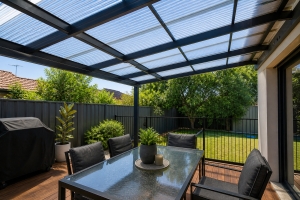
What is clear roof sheeting?
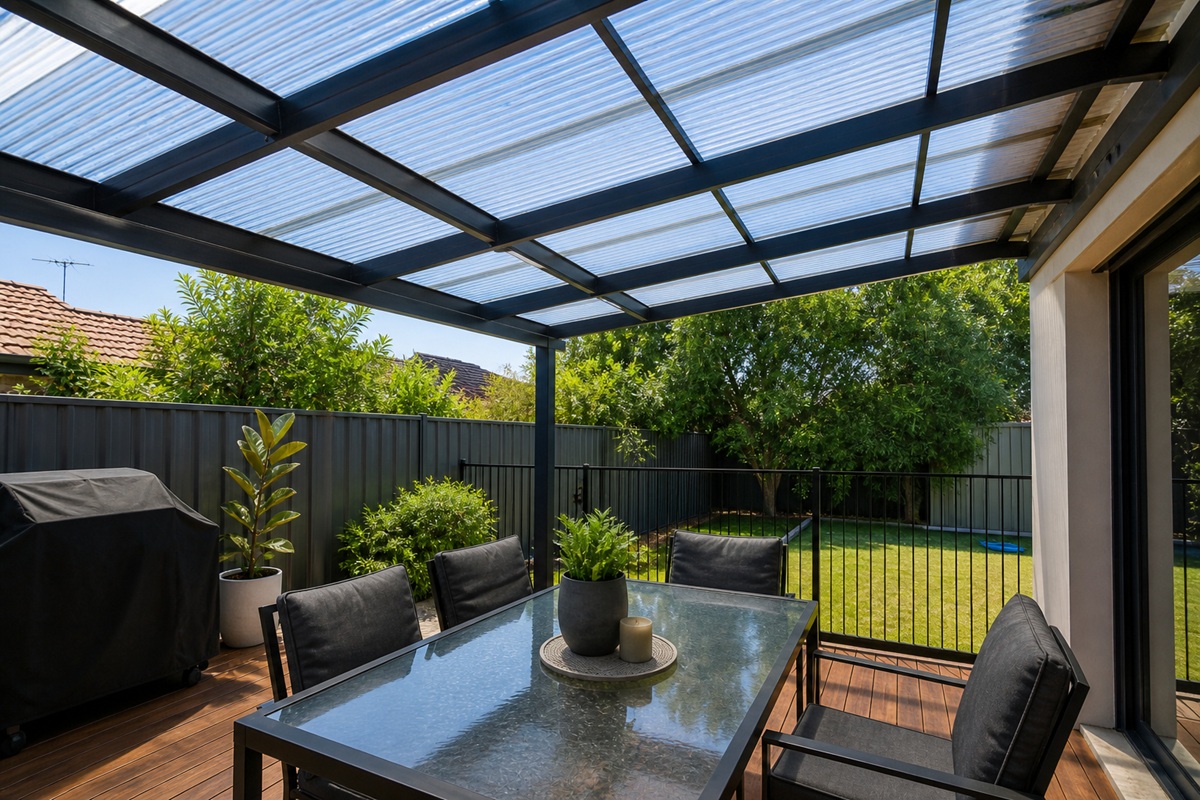
Clear roof sheeting is a popular way to bring natural light into outdoor areas without leaving them fully exposed to the weather. In Australia, it is commonly used over pergolas, patios, carports, walkways, and greenhouses. The most common clear roofing products are polycarbonate-based, although PVC, fibreglass, insulated systems, and glass can also be used depending on the application.
Clear roof sheets are often referred to as clear roof sheeting, polycarbonate roofing sheets, corrugated polycarbonate sheets, or transparent roofing sheets. In everyday use, many people also refer to them by brand names such as Suntuf and Laserlite, even though those are specific product ranges rather than generic material names.
The key to choosing the right sheet is understanding what you want the roof to do. Some people want maximum daylight, while others are more focused on heat reduction, durability, or cost. That is why clear roof sheeting is best thought of as a group of roofing options rather than one single product type.
What is polycarbonate roof sheeting?
Polycarbonate roof sheeting is a plastic roofing material designed for light transmission, outdoor durability, and impact resistance. SUNTUF is marketed as a profiled polycarbonate roofing sheet with UV protection, durability, a strong strength-to-weight ratio, and high light transmission, while Laserlite positions its corrugated polycarbonate sheets as residential roofing designed to handle Australian weather conditions.
In practical terms, this is why polycarbonate is so widely used over pergolas and patios. It lets daylight in, weighs much less than glass, and is designed to cope with weather, hail, and UV exposure better than many lower-grade clear plastics.
Is Suntuf better than Laserlite?
Neither is automatically better for every project. They are both established polycarbonate roofing options in Australia, but they highlight different strengths.
SUNTUF promotes UV protection, durability, impact resistance, light transmission of up to 90%, and tint options such as SolarSmart® designed to help reduce heat build-up. Laserlite highlights its Advanced Weatherguard™ Technology, claiming longer sheet life, longer colour and clarity retention, longer UV protection performance, and greater hail resistance compared with some other corrugated polycarbonate products. Laserlite also publishes a lifetime warranty for loss of light transmission and a 10-year weather breakage warranty on certain products.
For most buyers, the better question is not which brand is universally better, but which profile, tint, warranty, and performance characteristics best suit the project.
What are the disadvantages of polycarbonate roofing sheets?
One of the biggest disadvantages is thermal movement. Polycarbonate expands and contracts with temperature changes, which is why installation details matter. Laserlite’s own handling instructions warn that poor detailing and incompatible sealants can restrict movement and damage the sheets.
Another drawback is that clear roofing can allow a lot of light and heat through, especially if you choose fully clear sheets instead of heat-reducing or diffused options. Polycarbonate also needs careful cleaning, because abrasive cleaners, solvents, and incompatible chemicals can damage the sheet surface and may affect warranty coverage.
Although polycarbonate is impact resistant, it can still lose visual appeal over time if the wrong product is used, installed poorly, or exposed to harsh conditions without the right UV-stabilised specification.
Does it get hot under a polycarbonate roof?
Yes, it can. Clear polycarbonate roof sheeting allows in a lot of daylight, and with that comes solar heat. However, not every polycarbonate roof will perform the same way. Heat build-up depends on the sheet colour, tint, profile, roof orientation, ventilation, roof height, and whether the area is enclosed or open-sided. Palram’s SUNTUF range specifically includes heat-reducing tint options, which reflects the fact that heat control is a real consideration with transparent roofing.
A clear patio roof facing full western sun will behave very differently from a well-ventilated pergola fitted with heat-reducing sheets. If heat is a concern, the sheet selection and the overall structure design should be considered together.
Is polycarbonate cheaper than Colorbond?
Sometimes, but this is not a direct like-for-like comparison. Polycarbonate and Colorbond-style steel roofing are often chosen for different reasons. Polycarbonate is commonly used where daylight is wanted, while metal roofing is usually chosen where full shade, privacy, and a more solid roof build-up are the priority.
That means the decision should not come down to sheet price alone. The more useful comparison is what each roof system is meant to achieve in the finished space.
How long does a polycarbonate roof last?
A polycarbonate roof can last many years if you use a UV-stabilised product and install it correctly. As an example, Laserlite offers a 10-year warranty against certain weather breakage and a lifetime warranty relating to loss of light transmission on some products. Palram also promotes SUNTUF as a durable roofing sheet designed to maintain its appearance and performance for years.
In real-world use, lifespan still depends on exposure conditions, installation quality, support spacing, cleaning practices, and whether the selected product is suitable for the site.
Conclusion
Clear roof sheeting in Australia is most commonly polycarbonate-based, and for good reason. It offers a practical combination of daylight, low weight, impact resistance, and outdoor durability. Products such as Suntuf and Laserlite show that modern polycarbonate roofing can be tailored to different priorities, including clarity, weathering performance, and heat reduction.
At the same time, clear roofing is not automatically the best solution for every project. If heat, noise, opacity, or corrosion resistance matter more than daylight, alternatives such as fibreglass, PVC, or metal roofing may be a better fit. The best result usually comes from choosing the roofing material based on how the space will be used, not simply on the fact that it is clear.
At Statewide Building Products we recommend Laserlite sheeting, specifically Laserlite 2000, Laserlite 3000.
Contact our sales staff for more information - (08) 9399 3276.